REAL ESTATE · TRANCHE 2
AML/CTF compliance for Australian real estate agencies
If you buy, sell or manage real estate for clients, you are almost certainly a reporting entity. You need a documented program, customer due diligence on both sides of a transaction, screening, and records you can produce on demand.

- 1 July 2026AML/CTF obligations begin
- 29 July 2026Enrolment deadline with AUSTRAC
- 2029–2030First independent evaluation, staggered by enrolment identifier
Are you captured?
Real estate agencies were brought into the AML/CTF regime because property is one of the most reliable ways to move large amounts of money with a clean paper trail at the end. Capture turns on the service, not the licence — so the question is what you actually do for clients.
Likely captured
- Brokering the sale, purchase or transfer of real estate
- Selling or transferring real estate on behalf of a vendor
- Acting as a buyer's agent
- Handling deposits or client funds connected to a transaction
- Property management where you handle client money
- Off-the-plan and development sales
Generally outside scope
- Appraisals and market advice with no transaction
- Marketing and advertising services alone
- General administrative or clerical support to another agency
Capture depends on the designated services you provide — not on your profession, your licence or your job title.
What you need in place
Enrol and register with AUSTRAC
Every reporting entity has to be on the register. Enrolment is the entry point for everything else, including how your evaluation timing is set.
Appoint an AML/CTF compliance officer
A named person with the authority, seniority and time to run the program — and AUSTRAC has to be notified of the appointment.
Write an ML/TF risk assessment
Covering your customers, the designated services you provide, your delivery channels and the jurisdictions you deal with, with the reasoning visible.
Document your AML/CTF policies
Policies, procedures, systems and controls that follow from the risk assessment, approved by a senior manager rather than filed unread.
Run initial customer due diligence
Identify and verify your customer before you provide the designated service, at a depth that matches the risk you have assessed.
Screen for sanctions, PEPs and adverse media
Screening at onboarding and again over the life of the relationship, with the result recorded either way.
Trace beneficial ownership
Where the customer is a company, trust or other arrangement, identify who ultimately owns or controls it — and show how you got there.
Keep ongoing customer due diligence running
Monitoring is not an onboarding task. Relationships have to be reviewed and re-screened as risk and circumstances change.
Report suspicious matters
Submit suspicious matter reports within the required timeframes, plus threshold transaction reports where they apply to you.
Keep records
Generally seven years, with the retention clock starting at different points depending on the record type.
Train your people
Risk-appropriate AML/CTF training for staff, refreshed over time and delivered to new starters as they join.
Have the program independently evaluated
An independent evaluation of the whole program on the cycle your policies set, with findings tracked to closure.
See the evidence, not just the promise.
How True Comply helps
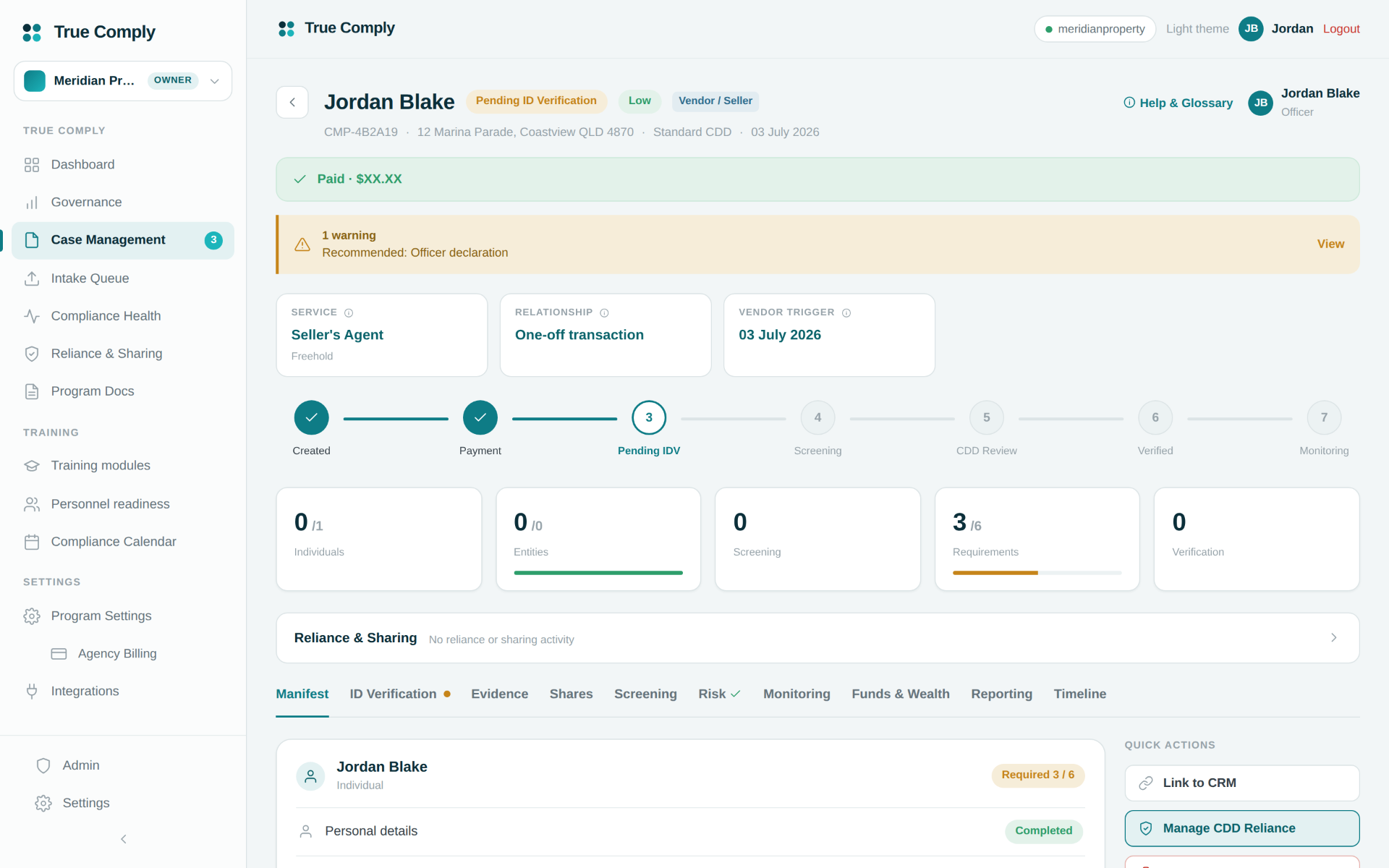
Verify a buyer or vendor in minutes
Identity verification on any device, by secure link, without the client coming into the office.
Screening and UBO tracing in the same case
A company purchaser doesn't become a research project — screening and ownership tracing sit inside the one file.
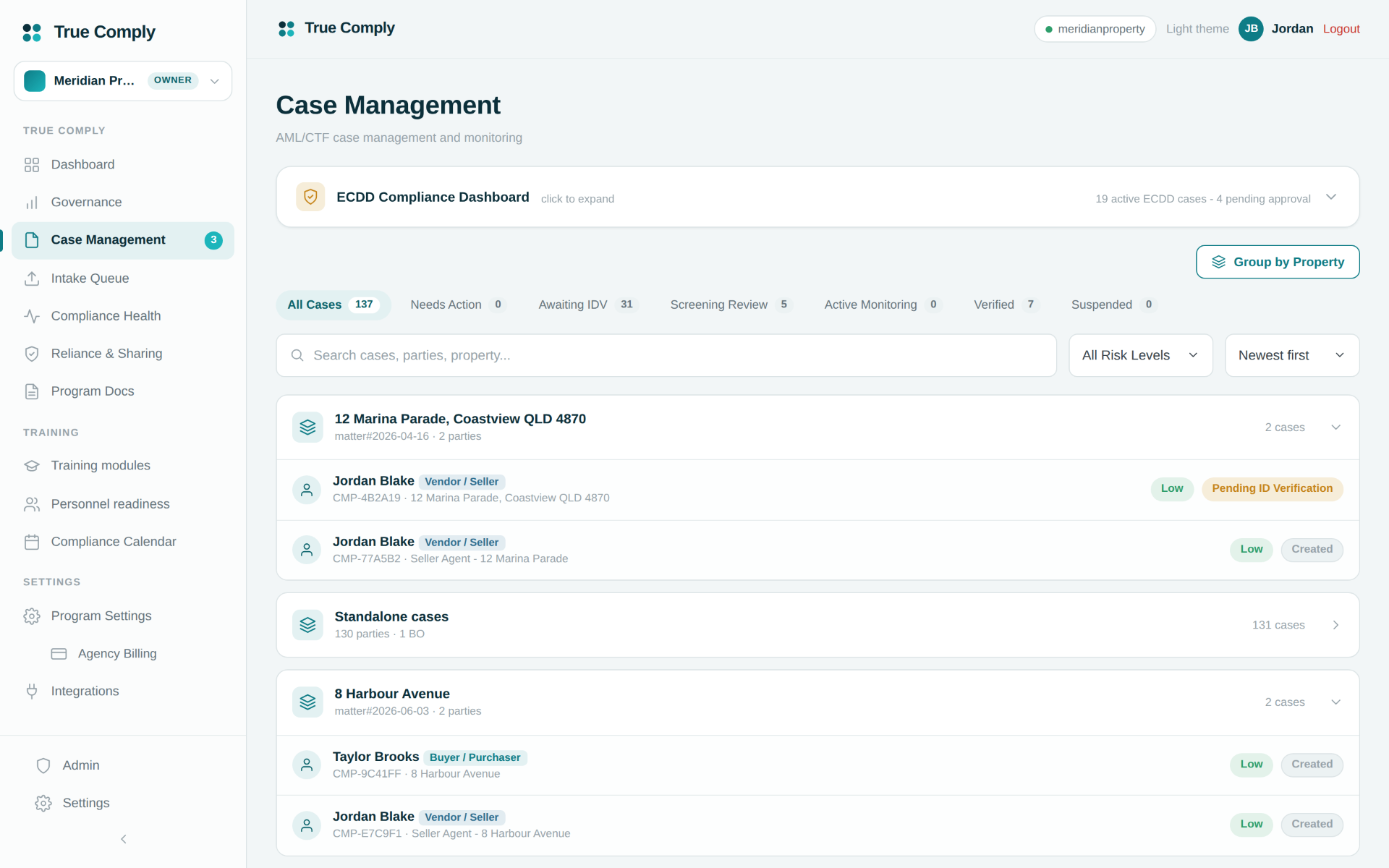
Cases grouped by property
A listing shows you every party to the transaction and exactly where each one is up to.
Ongoing monitoring across the book
Whole-book monitoring priced per person per month at your plan rate, so nothing goes stale.
A program pack built for an agency
An auto-generated risk assessment and policy set tailored to how an agency actually operates, not a generic template.
Senior AML judgement on call
When a file gets complicated, you have someone experienced to call rather than a help article.
Pay as you go, or a plan from $149 a month.
Pay as you go has no subscription — you pay for each check as you use it. Plans add included monthly credit and lower check rates, with monitoring from $1 per person per month on Advisory ($1,500 a month). All prices AUD, excluding GST, with no lock-in.
Questions, answered.
Already enrolled and working out what has to happen inside the agency? See our real estate operational readiness page.
Related insights
- Real estate
Tranche 2 is here: what it means for Australian real estate agencies
5 min read
- Scope
‘Are we even captured?’ How AML/CTF scope really works
4 min read
- How to
How to run customer due diligence that stands up
6 min read
- Getting compliant
You missed the 29 July enrolment deadline. What now?
5 min read
Compliance you can prove.
Tell us where you're at and we'll help you work out what applies to your business.
No jargon, no obligation.