ACCOUNTING · TRANCHE 2
AML compliance built for accounting practices
Not enrolled? Act now. Enrolment is only the first step.
If you are required to enrol and have missed your deadline to apply, you are already in breach of your enrolment obligation.
This does not apply to businesses that do not provide designated services, to businesses whose obligations commence later, or to businesses that applied on time and are awaiting processing. AUSTRAC enrolment guidance
An enrolment number does not make your practice compliant. You need an operating AML/CTF program, customer checks, risk controls and records that show what your team actually does. Gaps can expose your practice to financial penalties and criminal exploitation.
Enrolled already? You still need to manage the risk.
Enrolment records your business with AUSTRAC. It does not replace your risk assessment, customer due diligence, staff training, reporting or record keeping. A policy sitting in a folder is not enough: your team needs to use it.
Address overdue enrolment
Confirm which services bring your business into scope and address any overdue application promptly.
Put AML controls into daily work
Apply customer checks, train your team and manage the risks your business faces.
Keep evidence of compliance
Record your decisions, assign responsibility and track the gaps you address.
Non-compliance can carry financial penalties.
Failing to enrol or meet AML/CTF obligations can lead to enforcement action. AUSTRAC can issue infringement notices for relevant enrolment, program and customer-check failures, and seek court-imposed civil penalties. The outcome depends on the breach and circumstances.
AUSTRAC scrutiny has already begun.
AUSTRAC has announced section 167 information notices to apparently non-enrolled businesses, including accountants and real estate agents. These notices seek information; they are not findings of wrongdoing. Do not wait for a notice before checking your obligations.
Are you captured?
Accountants were captured for a narrow but important set of services. Compliance work — tax returns, BAS, general advice — generally sits outside. The structuring and client-money work is what brings a practice in.
Likely captured
- Forming companies, trusts, partnerships or other legal arrangements
- Acting as, or arranging for someone to act as, a nominee director, shareholder or trustee
- Managing client money, accounts or securities
- Assisting a client to plan or execute a sale or purchase of a business or shares
- Assisting with buying or selling real estate
- Providing a registered office or business address
Generally outside scope
- Preparing and lodging tax returns and BAS
- Bookkeeping and payroll
- Audit and assurance
- General business and tax advice
Capture depends on the designated services you provide — not on your profession, your licence or your job title.
What you need in place
Enrol and register with AUSTRAC
Every reporting entity has to be on the register. Enrolment is the entry point for everything else, including how your evaluation timing is set.
Appoint an AML/CTF compliance officer
A named person with the authority, seniority and time to run the program — and AUSTRAC has to be notified of the appointment.
Write an ML/TF risk assessment
Covering your customers, the designated services you provide, your delivery channels and the jurisdictions you deal with, with the reasoning visible.
Document your AML/CTF policies
Policies, procedures, systems and controls that follow from the risk assessment, approved by a senior manager rather than filed unread.
Run initial customer due diligence
Identify and verify your customer before you provide the designated service, at a depth that matches the risk you have assessed.
Screen for sanctions, PEPs and adverse media
Screening at onboarding and again over the life of the relationship, with the result recorded either way.
Trace beneficial ownership
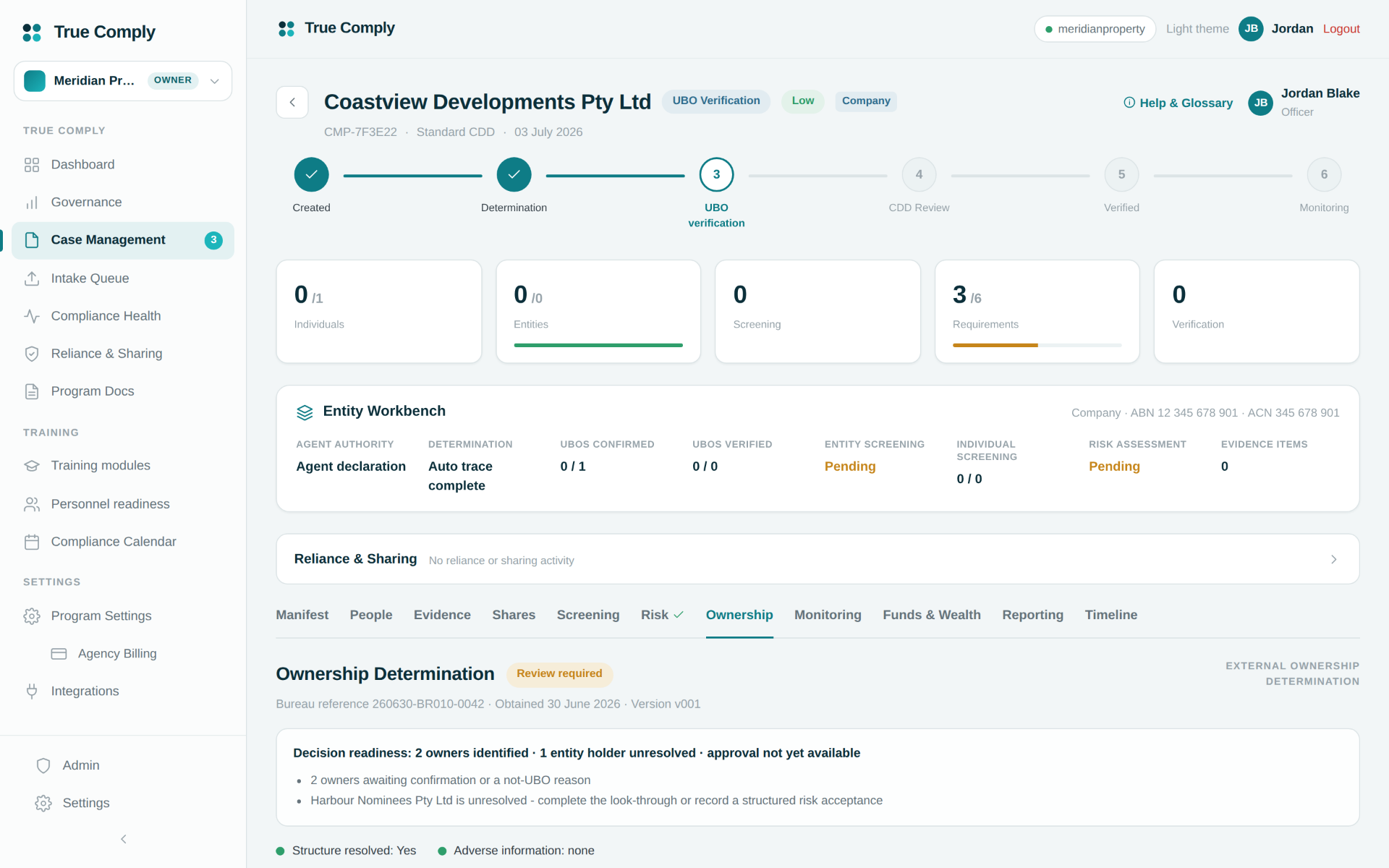
Where the customer is a company, trust or other arrangement, identify who ultimately owns or controls it — and show how you got there.
Keep ongoing customer due diligence running
Monitoring is not an onboarding task. Relationships have to be reviewed and re-screened as risk and circumstances change.
Report suspicious matters
Submit suspicious matter reports within the required timeframes, plus threshold transaction reports where they apply to you.
Keep records
Generally seven years, with the retention clock starting at different points depending on the record type.
Train your people
Risk-appropriate AML/CTF training for staff, refreshed over time and delivered to new starters as they join.
Have the program independently evaluated
An independent evaluation of the whole program on the cycle your policies set, with findings tracked to closure.
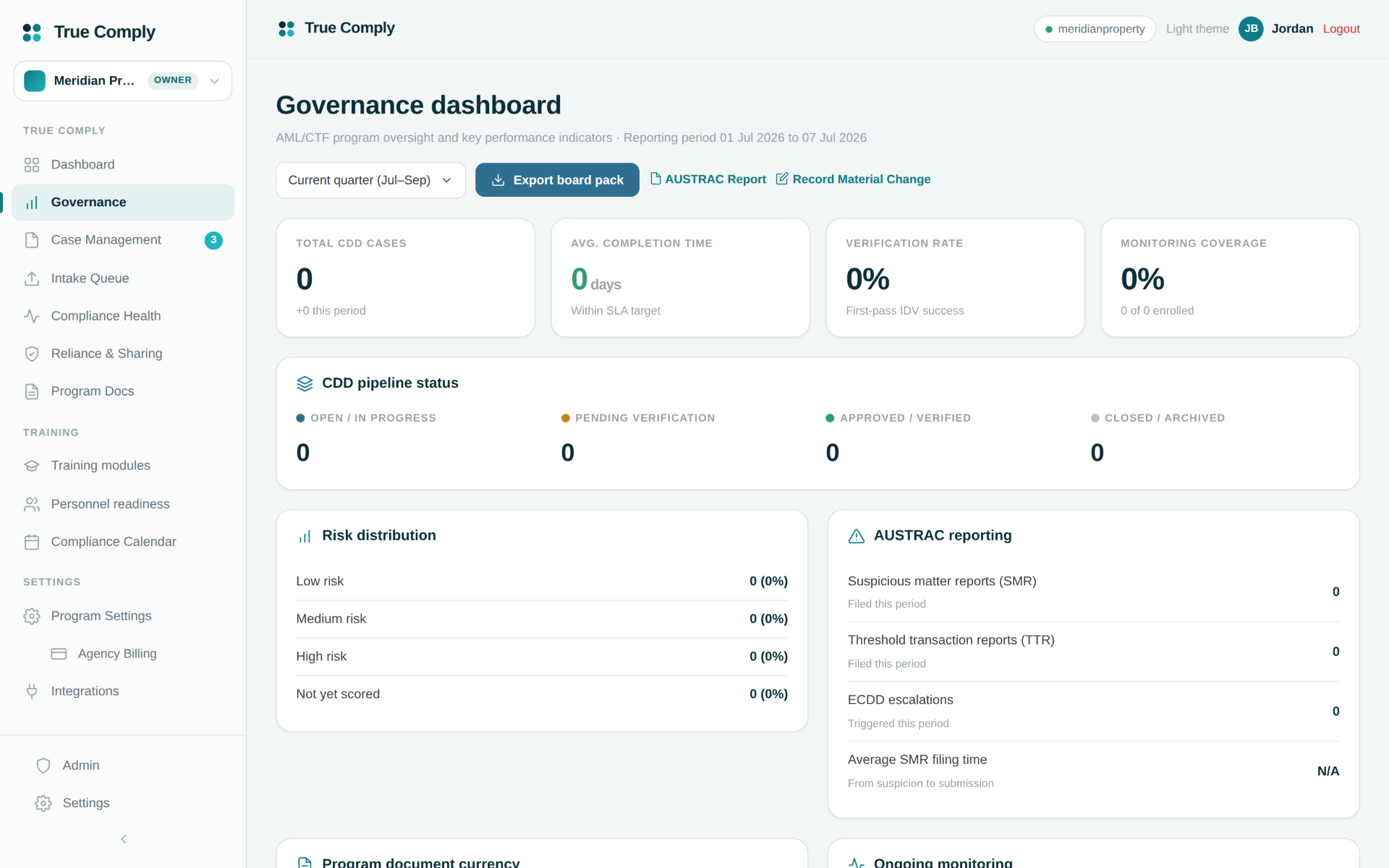
See the evidence, not just the promise.
How True Comply helps
Identify captured engagements at intake
So you are not applying customer due diligence to every tax return you lodge.
Verify a client in minutes
Verification by secure link, rather than chasing certified copies through the post.
Full beneficial ownership tracing
For the trust and company structures you set up, with the reasoning recorded.
One case per client
A single record that follows the client across engagements and financial years.
Ongoing monitoring across the book
Your client book stays monitored, priced per person per month at your plan rate.
A program pack for an accounting practice
Plus senior judgement on call when a structure gets complicated.
Pay as you go, or a plan from $149 a month.
Pay as you go has no subscription — you pay for each check as you use it. Plans add included monthly credit and lower check rates, with monitoring from $1 per person per month on Advisory ($1,500 a month). All prices AUD, excluding GST, with no lock-in.
Questions, answered.
Primary sources: AUSTRAC enrolment overview and AUSTRAC: consequences of not complying. General information only, not legal advice — obligations depend on the designated services your business provides.
Related insights
- Accounting
Tranche 2 and your accounting practice: which services are captured
5 min read
- Scope
‘Are we even captured?’ How AML/CTF scope really works
4 min read
- How to
Beneficial ownership: finding who is really behind a company
5 min read
- Getting compliant
Your AML/CTF obligations, in plain English
6 min read
Start the conversation
Tell us where your practice is at.
A short note is enough — we'll come back to you with practical next steps. No jargon, no obligation.
Compliance you can prove.
Tell us where you're at and we'll help you work out what applies to your business.
No jargon, no obligation.