GAMBLING & WAGERING · REFORMED OBLIGATIONS
AML/CTF compliance for Australian gambling and wagering operators
This sector has drawn more enforcement attention than any other, and the reforms have raised the bar again — a rebuilt program framework, a reformed CDD regime, and a new threshold that changes who you have to know.

Already regulated? The regime still changed.
The reforms did not just add new sectors. From 31 March 2026 the program structure, customer due diligence framework and governance obligations changed for every existing reporting entity, and independent reviews of Part A became independent evaluations of the whole program. A program that was compliant in February needed rebuilding, not refreshing.
- 31 March 2026Reformed obligations begin, including the new $5,000 threshold for certain gambling services
- 30 May 2026AML/CTF compliance officer notified to AUSTRAC
- 1 July 2026Transitional CDD policies had to be documented
- 31 March 2027Earliest first independent evaluation for existing entities
- 31 March 2029ACIP transitional period ends
Are you captured?
Gambling operators have been reporting entities for a long time and have seen what enforcement looks like when a program does not work in practice. The reforms changed the framework underneath every one of those programs, and added a threshold change that reaches further into ordinary venue operations than many operators first assumed.
Likely captured
- Casino gaming and account-based play
- Operating gaming machines in a club, pub or hotel
- Bookmaking on any event, on-course or online
- Operating a lottery, pool or prize game
- Accepting and paying out on wagering accounts
- Exchanging chips, tokens or credits for money
Generally outside scope
- Food, beverage and accommodation services in a venue
- Ticketing and entertainment with no gambling element
- Loyalty programs that do not involve a designated service
Capture depends on the designated services you provide — not on your profession, your licence or your job title.
What you need in place
Enrol and register with AUSTRAC
Every reporting entity has to be on the register. Enrolment is the entry point for everything else, including how your evaluation timing is set.
Appoint an AML/CTF compliance officer
A named person with the authority, seniority and time to run the program — and AUSTRAC has to be notified of the appointment.
Write an ML/TF risk assessment
Covering your customers, the designated services you provide, your delivery channels and the jurisdictions you deal with, with the reasoning visible.
Document your AML/CTF policies
Policies, procedures, systems and controls that follow from the risk assessment, approved by a senior manager rather than filed unread.
Run initial customer due diligence
Identify and verify your customer before you provide the designated service, at a depth that matches the risk you have assessed.
Screen for sanctions, PEPs and adverse media
Screening at onboarding and again over the life of the relationship, with the result recorded either way.
Trace beneficial ownership
Where the customer is a company, trust or other arrangement, identify who ultimately owns or controls it — and show how you got there.
Keep ongoing customer due diligence running
Monitoring is not an onboarding task. Relationships have to be reviewed and re-screened as risk and circumstances change.
Report suspicious matters
Submit suspicious matter reports within the required timeframes, plus threshold transaction reports where they apply to you.
Keep records
Generally seven years, with the retention clock starting at different points depending on the record type.
Train your people
Risk-appropriate AML/CTF training for staff, refreshed over time and delivered to new starters as they join.
Have the program independently evaluated
An independent evaluation of the whole program on the cycle your policies set, with findings tracked to closure.
Apply the new $5,000 threshold
A new $5,000 threshold applies to certain gambling services from 31 March 2026. Check where it reaches into your venue operations and whether your systems detect it.
Make the program work on the floor, not just on paper
Enforcement in this sector has consistently turned on the gap between a documented program and what staff actually did. Evidence of operation is the point.
Handle account-based and anonymous play differently
Account-based wagering, cash play and chip exchange present very different risk profiles and should not share a single control set.
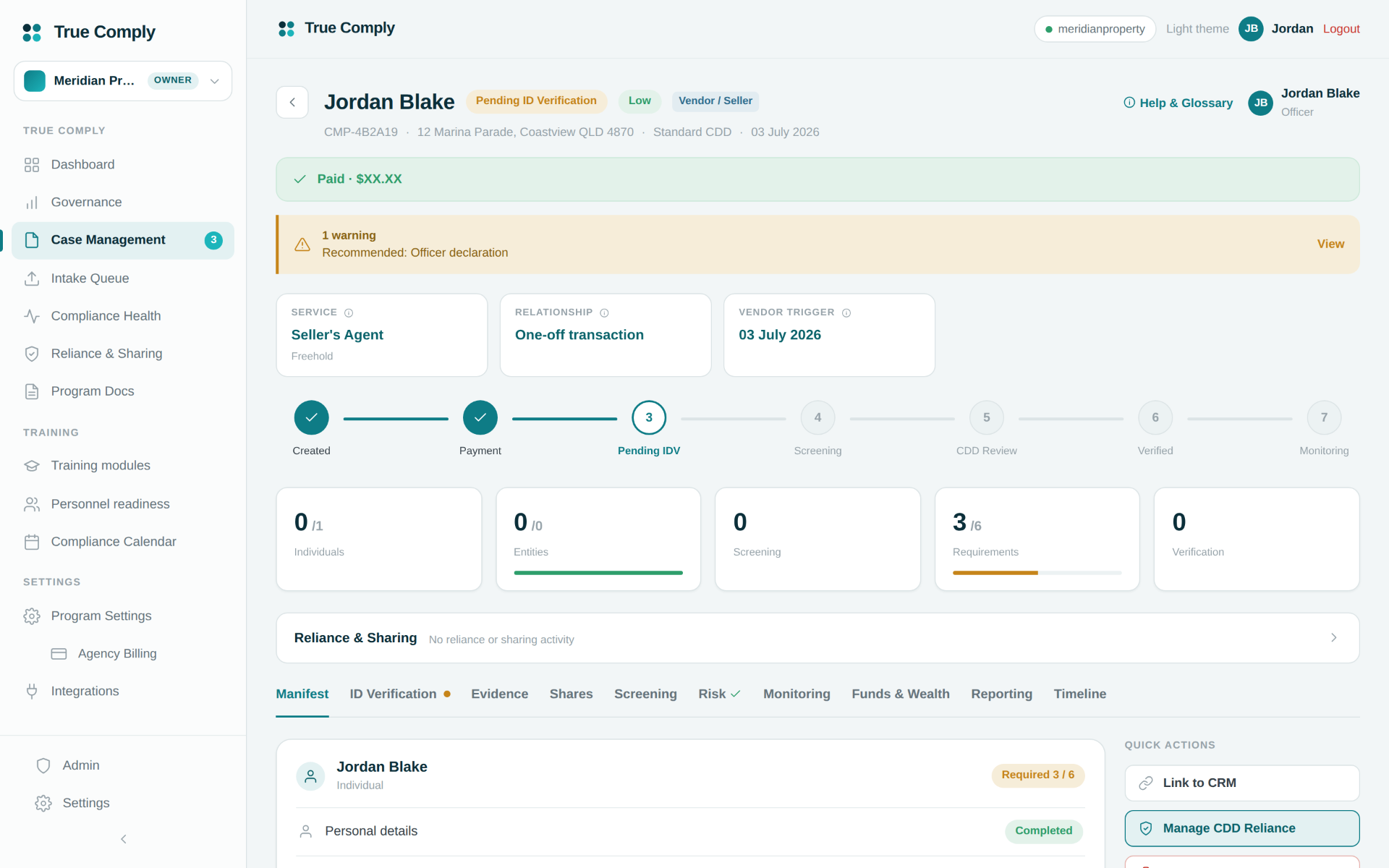
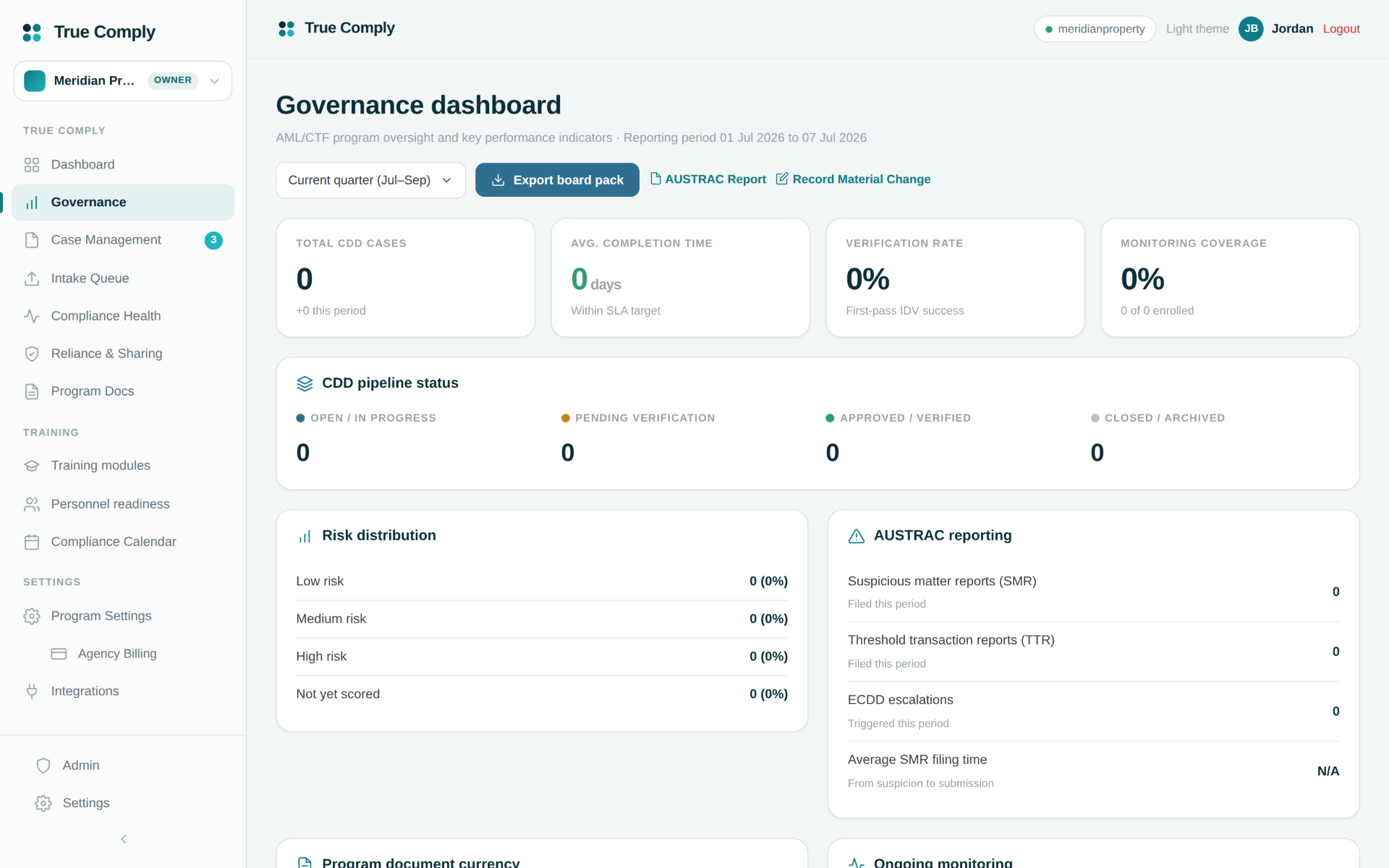
See the evidence, not just the promise.
How True Comply helps
Customer verification that works at the counter
Fast, mobile verification that does not create a queue.
Screening with the decision recorded
Sanctions, PEP and adverse media, with the reasoning captured at the moment of the call.
Threshold detection and reporting evidence
Clear records supporting threshold and suspicious matter reporting.
Ongoing monitoring across the patron base
Priced per person per month at your plan rate, so a changed risk profile surfaces on its own.
A program that survives contact with the venue
Designed around how staff actually work, because that is what gets tested.
Senior advisory for a scrutinised sector
Experienced judgement when the questions get difficult.
Pay as you go, or a plan from $149 a month.
Pay as you go has no subscription — you pay for each check as you use it. Plans add included monthly credit and lower check rates, with monitoring from $1 per person per month on Advisory ($1,500 a month). All prices AUD, excluding GST, with no lock-in.
Questions, answered.
Related insights
- Technology
Compliance you can prove: why evidence beats a policy binder
4 min read
- Assurance
Your first independent evaluation: what AUSTRAC actually expects
6 min read
- Getting compliant
Have you already hit 'set and forget' on your AML program?
5 min read
- How to
How to run customer due diligence that stands up
6 min read
Compliance you can prove.
Tell us where you're at and we'll help you work out what applies to your business.
No jargon, no obligation.