
Why the regime cares
Companies and trusts are legitimate and everywhere. They are also the standard mechanism for putting distance between a person and their money. Beneficial ownership tracing exists because verifying the director who walks into your office tells you very little about who ultimately benefits from the transaction.
Ownership and control are two different tests
The common starting point is a shareholding threshold — typically identifying individuals who ultimately own or control 25 per cent or more of a company. That is the ownership limb, and it is the easier one.
The control limb catches what the percentage misses. A person can control a company through voting rights, the power to appoint or remove directors, a shareholders' agreement, or simply by being the person whose instructions the directors follow. Someone with no shares at all can be a beneficial owner. If no one meets the ownership test, you generally fall back to the individuals who exercise control, and ultimately to those in senior managing positions.
Layered structures multiply the work
Ownership by another company is not an answer — it is another layer. You keep going until you reach natural persons. A company owned by two holding companies, each owned by a trust, can require a dozen searches to resolve, and the intermediate entities may be registered offshore where the register tells you less.
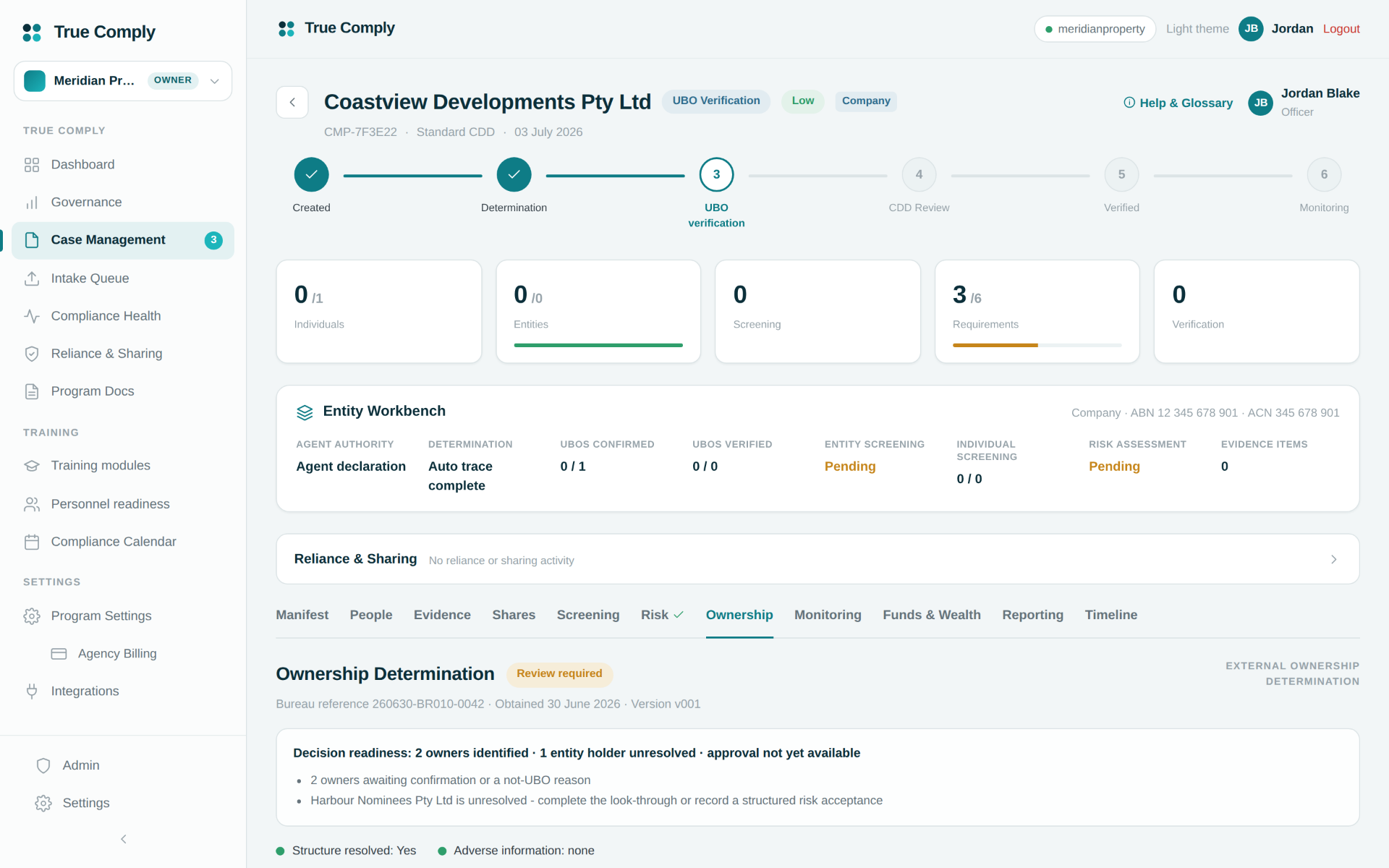
Trusts need their own treatment. You are generally looking at the trustee, the settlor, the appointor or protector who can change the trustee, and the beneficiaries or classes of beneficiary. A discretionary trust with a broadly drawn beneficiary class is a common point where this becomes genuinely difficult.
Do not rely on the client's version alone
A structure diagram supplied by the customer is a useful starting point and not verification. It should be checked against independent sources — company registers, constitutional documents, trust deeds — and any difference between what you were told and what you found is itself a risk signal worth recording.
When the trail goes cold
Sometimes you cannot fully resolve ownership. That is not automatically a reason to walk away, but it is a reason to escalate: record precisely where the trail stopped and why, apply enhanced due diligence, get senior sign-off, and consider whether the opacity itself warrants a suspicious matter report. What you must not do is leave the field blank and proceed as though the question was never asked.
True Comply traces full beneficial ownership as part of the case record, so the structure, the sources and the reasoning sit in one place. Start the conversation if you would like to see it on a real structure.
Read next
Find your sector →Related insights
- How to run customer due diligence that stands up
How to · 6 min read
- Tranche 2 and your accounting practice: which services are captured
Accounting · 5 min read
- What to look for in an AML/CTF platform
Choosing a solution · 6 min read
Sector guide: AML/CTF compliance for accounting practices