
Option one: do it manually
A template program, a spreadsheet register, ID documents saved into matter folders, and free sanctions lists checked by hand.
It genuinely works for a very small firm with a handful of low-risk, low-complexity clients and someone diligent enough to keep it current. It is cheap and you own it completely.
It breaks in three predictable places. Ongoing monitoring is the first — nobody rescreens a spreadsheet of 300 clients weekly, so in practice it stops happening. Complex ownership is the second, because manual UBO tracing through layered structures is genuinely hard. Retrieval is the third: reconstructing a two-year-old decision from folders and email threads is slow at best and impossible when the person who did the work has left.
Option two: outsource to a consultant
Engage an AML consultant to write the program, sometimes act as external compliance officer, and review periodically.
You get expertise immediately, which matters when nobody internally has done this before, and the documentation is usually strong. For a firm with genuinely complex circumstances, that senior judgement is worth paying for.
Where it falls short is the daily work. Consultants build and review; they are rarely the ones running due diligence on every client you onboard next Tuesday. Firms often end up with an excellent program and no operating capability behind it — the binder is right, the practice is not. It is also the most expensive option to run continuously.
Option three: compliance software
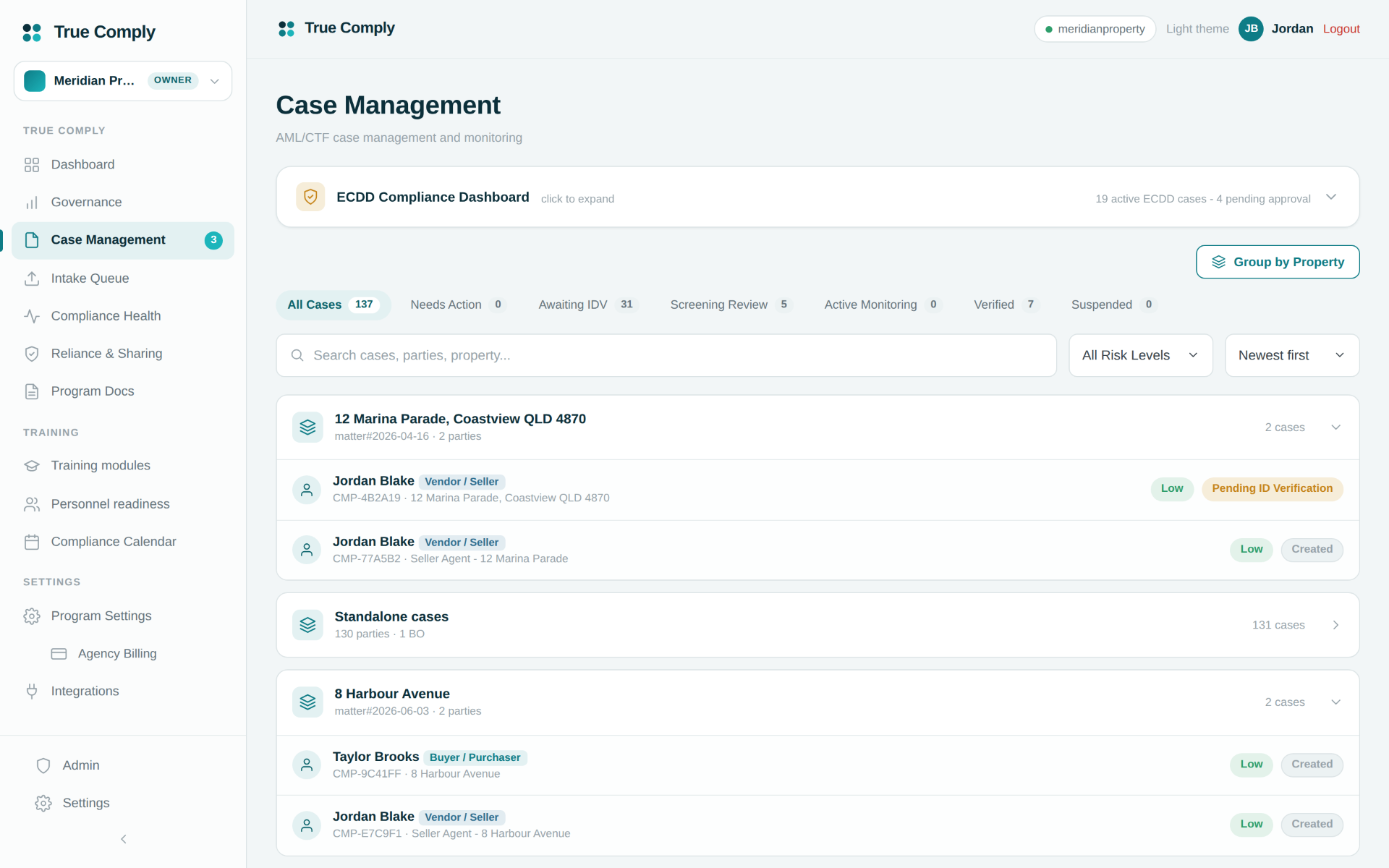
A platform that handles verification, screening, ownership tracing, monitoring and record-keeping in one place.
It handles volume and repetition well, monitoring actually happens because it is automated, and the evidence trail builds itself as a by-product of the work. Cost per client falls as you grow.
The honest limitation: software does not make judgement calls. It will not decide your risk appetite, write a risk assessment that reflects your business, or be your compliance officer. A firm that buys a platform expecting it to think has bought the wrong thing.
Most firms end up combining two
In practice the durable answer for a mid-sized captured firm is expert judgement to design the program and platform capability to run it — the consultant model for the thinking, the software model for the doing.
That combination is what True Comply is built around, which is not a neutral position and we would rather say so plainly. If you are weighing these three approaches, start the conversation and we will give you a straight view of which one fits your size and risk — including when that answer is not us.
Read next
Find your sector →Related insights
- What to look for in an AML/CTF platform
Choosing a solution · 6 min read
- Compliance you can prove: why evidence beats a policy binder
Technology · 4 min read
- Have you already hit 'set and forget' on your AML program?
Getting compliant · 5 min read